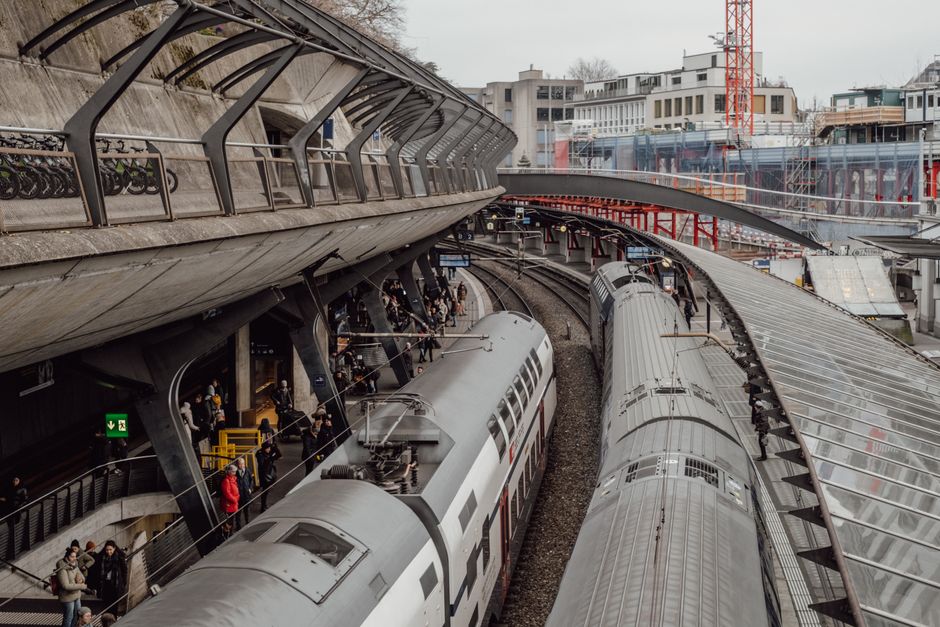
You have nine days in April, a backpack, and a route that starts in Amsterdam, crosses Germany, reaches Prague, and ends in northern Italy. The obvious question is not whether trains are pleasant. It is whether paying for an Interrail Pass gives you enough usable travel to beat ordinary tickets.
The answer for spring 2026 is clear: Interrail is worth it when your trip includes several long rail journeys and at least one change of plan. It is poor value for a short, fixed route built around early-booked high-speed tickets. Spring helps because March, April, and much of May usually bring lower demand than July and August, but compulsory reservations can still change the maths.
Why spring rail travel works before summer crowds
Spring rail travel solves a practical problem: it lets you connect several city centres without paying for airport transfers, losing half a day to security lines, or locking every movement to one ticket. The deeper value is flexibility. A rail pass gives the journey itself a place in the trip, so a rainy morning in Vienna can become an afternoon in Salzburg instead of a wasted hotel day.
Lower demand does not mean empty trains
March and April often offer more breathing room than peak summer, especially on regional trains. May becomes busier around public holidays, school breaks, and popular events. High-speed services such as Eurostar, SNCF TGV, and Trenitalia Frecciarossa can still sell out or restrict pass-holder seats. The right assumption is modest demand, not unlimited availability.
The pass solves uncertainty, not every cost
An Interrail Global Pass covers eligible rail travel across 33 European countries, but it does not cover hotels, city buses, airport transfers, or every reservation. A travel day runs from midnight to 23:59 Central European Time, and you can take multiple eligible trains during that day. That makes a pass useful for a two-train transfer day, but less useful for a week spent walking around one city.
What counts as an Interrail travel day?
A travel day is not a single train ride. It is a calendar day on which the pass can cover multiple eligible journeys. That distinction makes route design more important than the number of train bookings.
- List every long-distance move. Write down the date, departure city, arrival city, and likely train type.
- Group same-day connections. Amsterdam to Cologne and Cologne to Berlin may use one travel day if both journeys happen on the same date.
- Separate sightseeing days from transfer days. Spending three nights in Florence should not consume three pass days if you take no train.
- Check the pass network. Participating operators include DB, ÖBB, SBB, SNCF, Trenitalia, RENFE, and many regional railways, but coverage differs by service.
- Protect the arrival day. A late departure can cross midnight and create a second travel-day problem, especially on night trains.
One travel day can cover a dense route
Suppose you travel from Munich to Innsbruck in the morning and continue to Verona in the afternoon. If both trains run on the same calendar date and accept the pass, that is normally one travel day. The pass becomes more valuable when your route has several linked segments rather than one isolated journey.
Home-country rules limit the first and last leg
For residents of an eligible European country, the Global Pass normally permits one outbound and one inbound journey in the country of residence. It is not a general commuter ticket for unlimited travel at home. Travellers who live outside the Interrail area usually need a Eurail Global Pass instead, so confirm eligibility before comparing prices.
Reservations can decide the real cost
Reservations are the main reason a pass that looks cheap can become expensive. The pass itself does not guarantee a seat. Most local and many regional trains let you board without a reservation, but high-speed and international services often require one. Night trains normally require a paid seat, couchette, or sleeper reservation. On some routes, the railway limits the number of seats available to pass holders even when ordinary tickets remain for sale.
Common spring reservation pressure points
Eurostar services between the United Kingdom and continental Europe require advance reservations for pass holders. SNCF TGV trains in France usually require them as well, and popular departures may have limited pass-holder inventory. Trenitalia Frecciarossa services generally need a reservation, while some Italian regional trains do not. ÖBB Nightjet services require reservations for sleeping accommodation and often for seated travel.
Interrail’s reservation system commonly adds a €2 per-person, per-train booking fee. The railway reservation itself varies by route and class. A night-train berth can cost far more than a daytime regional seat. Five high-speed reservations at €10 each add €50 to a €239 pass, producing a practical cost of €289 before accommodation or local transport.
Reservation-free routes can protect the budget
The best spring strategy is to compare two versions of each long journey. The first uses the fastest train. The second uses regional or slower InterCity services that accept the pass without a mandatory reservation. A three-hour trip may become five hours, but saving €15 to €40 on one segment can matter across a multi-city route. Do not choose a slower train when it forces an extra hotel night; the saving can disappear immediately.
Book scarce seats before activating the pass
Seat inventory is a planning risk, not a minor detail. Check the Rail Planner app and the operator’s own timetable before buying a non-refundable promotional fare or activating the pass. For Easter travel, May public holidays, and Friday afternoon departures, reserve early. The pass is most useful when it gives you route flexibility, so avoid building the entire trip around trains with tiny pass-holder quotas.
Where Interrail works best in spring
My pick for the strongest spring use case is a Central European loop. Germany, Austria, Czechia, Switzerland, and northern Italy combine dense rail networks with many regional alternatives. That gives a pass holder room to change cities without paying a new full-fare ticket every time.
The Central European loop
A practical route could run Munich, Salzburg, Vienna, Prague, Dresden, and Berlin. Several legs can be handled by DB, ÖBB, and Czech rail services, and the distances are long enough for the pass to earn its keep. Spring scenery is also a real benefit: Alpine routes are attractive before peak-season crowds, while city temperatures are usually manageable for walking.
When southern routes need more care
Italy and France can still work, but the calculation is tighter because many desirable long-distance trains require reservations. A five-day pass used on Milan to Florence, Florence to Rome, Rome to Paris, and Paris to London may collect enough reservation charges to erase the flexibility premium. For this route, compare the pass against early-booked Frecciarossa, TGV, and Eurostar fares before purchasing.
When a rail pass is the wrong tool
A rail pass is not automatically the responsible choice. It is usually the wrong tool when the itinerary has one base, two short train rides, or fixed high-speed departures that can be booked cheaply in advance.
Question: Are you visiting only one region?
If your trip is limited to five days in Italy, a local rail strategy may win. Regional tickets and advance Frecciarossa fares can cost less than a multi-country pass, especially when you know the exact dates. A One Country Pass may be worth checking for heavy movement, but it should not be treated as a default upgrade.
Question: Are your dates completely fixed?
Fixed dates remove much of the pass’s main advantage. Compare each route at the moment you are ready to buy. If Amsterdam to Paris, Paris to Zurich, and Zurich to Milan are all available at low advance fares, separate tickets can leave more money for accommodation.
Question: Will you spend most days in cities?
Five rail days over a 14-day holiday can be efficient. Five rail days used only because the pass was purchased is not. Long museum days, beach stays, and hiking bases create unused pass capacity. Buy movement, not the fantasy of movement.
Who should buy Interrail for spring 2026?
The verdict is specific. Buy the Interrail Global Pass if you are taking at least four substantial rail journeys, crossing several countries, and want room to alter the route. For many travellers, the five-day pass at €239 is the best starting point; choose seven days at €286 when the itinerary includes two additional long transfers. Add expected reservations before making the final decision.
Best fit: flexible multi-country travellers
The pass suits a traveller who may replace Vienna with Ljubljana, add a stop in Innsbruck, or take a slower scenic train to avoid a reservation. It also suits families and young travellers who value simple mobile ticket management, provided everyone’s eligibility and class are checked correctly.
Best alternative: early-booked point-to-point tickets
Separate tickets win when the route is short, dates are firm, and the available fares are well below €47.80 per travel day. They also win when every appealing train carries a reservation surcharge. The practical decision is a spreadsheet with the pass, reservations, and comparable tickets in separate rows.
Spring rail travel is moving toward a more flexible mix of mobile passes, operator apps, and advance fares. Interrail remains valuable when freedom has a real purpose, not when the pass simply feels like the European way to travel.